Data Masker Home

Net 2000 Ltd. Home

Data Masker for SQL Server Databases
Frequently Asked Questions List

This FAQ is for the SQL Server version of the Data Masker software. There is a separate FAQ for the Data Masker for Oracle version.

Section Summary

Questions about What Data Masker Is and Does
[01.00] Where is the latest version of this FAQ?
[01.01] How about a summary of what Data Masker does?
[01.02] Who wrote Data Masker and why?
[01.03] How can I contact the publishers of Data Masker?
[01.04] I have an idea for a new/better feature - do you want to hear about it?

Version and Operating System Questions

[02.01] What is the current release version of Data Masker?
[02.02] What are the PC system requirements for Data Masker?
[02.03] What are the server side requirements for Data Masker?
[02.04] What SQL Server database versions does Data Masker support?
[02.05] What version of Data Masker am I currently using?
[02.06] How can I see or edit my activation key?
[02.07] How do I upgrade Data Masker?
[02.08] What other databases besides SQL Server does Data Masker support?

'How do I' and 'Can I' Type Questions

[03.01] How big a table can Data Masker work on?
[03.02] Can I share my Masking Set with other users?
[03.03] Can a table have more than one Masking Rule?
[03.04] Can a column in a table have more than one Masking Rule on it?
[03.05] My database has foreign keys, can Data Masker still scramble the data?
[03.06] My database has primary keys, can Data Masker still scramble the data?
[03.07] Can I add multiple target databases to a Masking Set?
[03.08] If I have multiple target databases do they have to be in the same SQL Server instance?
[03.09] Can I define a Substitution Rule which uses the contents of a different table to determine which rows are updated in the primary table?
[03.10] If I update a column, can I update another column with the same value?
[03.11] Can I synchronize the data in one column of a table with the data in another column without changing the data in the first column?
[03.12] Can I apply a rule to synchronize the data between tables in different databases?
[03.13] Can I make one rule only execute after another rule completes?


Questions about What Data Masker Is and Does

[01.00] Where is the latest version of this FAQ?

The latest version of the Data Masker FAQ can be found on the Data Masker web site at http://www.DataMasker.com/dms_FAQ.htm
[01.01] How about a summary of what Data Masker does?
The basic function of Data Masker is to replace sensitive data in test and development databases with realistic looking but false information. This process is sometimes called Data Sanitization, Data Masking or Data Protection.

The Data Masker software provides a simple to use, push button method of securing the information in test environments. The Data Masker Key Features document contains much more information on why Data Masker is useful and how it works.

[01.02] Who wrote Data Masker and why?
The Data Masker software is published by Net 2000 Ltd. in order to fulfil a real need in the SQL Server database community. Net 2000 Ltd. also publishes other useful software.

Data Masker for Oracle
A product similar to the SQL Server version which scrambles and masks data in Oracle databases.
DataBee
Software designed to create a database which is a referentially correct subset of the data in a large Oracle database.
DDL Wizard
Free software which can parse export files and re-generate the DDL build scripts from them.
[01.03] How can I contact the publishers of Data Masker?
Any email to DataMasker@DataMasker.com will get to us. The full contact details of Net 2000 Ltd. are on this page.
[01.04] I have an idea for a new/better feature - do you want to hear about it?
For sure we do. Please E-mail DataMasker@DataMasker.com.

Version and Operating System Questions

[02.01] What is the current release version of Data Masker?
The current production release of the Data Masker for SQL Server software is v01.01.
[02.02] What are the PC system requirements for Data Masker?
Data Masker works on Windows 98, NT4, Windows 2000, and Windows XP. The Data Masker for SQL Server software requires the .NET v1.1 Common Language Runtime (CLR) to be installed on the PC. This software is freely available from Microsoft. There are no really large hardware requirements - any reasonably new Pentium PC with more than 256Mb of memory should be sufficient. A reasonably large monitor is desirable (but not essential) and the screen resolution should be 800x600 or greater.

The Data Masker software itself takes up very little space - 25 Mb of disk space should be more than sufficient.

[02.03] What are the server side requirements for Data Masker?
Not very much. Data Masker requires a small DLL and some data set files to be installed in the Binn directory of the target SQL Server instance. Extended stored procedures need to be created in the SA account of the target instance to interact with the Data Masker DLL. The installed data sets contain the replacement information used by the Substitution masking rules.

The server side installation and configuration is quite simple and is entirely automated by the Data Masker SQL Server Configuration Tool.

[02.04] What SQL Server versions does Data Masker support?
Data Masker supports SQL Server version 7, 2000 and 2005.
[02.05] What version of Data Masker am I currently using?
Every copy of Data Masker contains version information in the About Data Masker form. To see this form start any Data Masker application and click on the Mask logo in the upper right hand corner.
[02.06] How can I see or edit my activation key?
The Activation key is visible on both the About and Key Request forms. See the FAQ question [02.05] for information on the About Data Masker form. A new evaluation or licensed activation key can be requested by pressing the Request New Key button on the About Data Masker form.
[02.07] How do I upgrade Data Masker?
Just get the latest version from the web site (http://www.DataMasker.com) and re-install. You do not need to uninstall first and you can skip as many versions as you wish. Your saved settings and activation keys will be preserved. You will, however, need to re-install the server side binaries to make sure that the DLL is at the same version as the Data Masker Client software and to take advantage of any new Data Sets that have been released.
[02.08] What other databases besides SQL Server does Data Masker support?
The Oracle version of Data Masker is available now. MySQL, VSAM, flat file versions are planned.


'How do I' and 'Can I' Type Questions

[03.01] How big a table can Data Masker work on?
There is no size limit really. The masking process is broken up into reasonably sized chunks with frequent commits so that you do not need to worry about excessive resource consumption on the server.
[03.02] Can I share my Masking Set with other users?
Sure. It is designed for this. However, be aware that Masking Sets are designed for a specific purpose and will operate against a designated database. If you share the Masking Set you should be sure that the recipient really knows what the set will do and wants the data in the target database changed in that way.
[03.03] Can a table have more than one Masking Rule?
Absolutely, in fact this is the usual case. Place as many Masking Rules on a table as you need to scramble the data in the columns.
[03.04] Can a column in a table have more than one Masking Rule on it?
Yes you can. This is frequently done if WHERE Clause options are used.
[03.05] My database has foreign keys, can Data Masker still scramble the data?
Yes it can, use a Table-To-Table Synchronization rule to perform the appropriate update.
[03.06] My database has primary keys, can Data Masker still scramble the data?
Yes it can, but you will have to ensure that you update with unique data that is not already in use in the primary or unique key. Many data sets have options for this purpose.
[03.07] Can I add multiple target databases to a Masking Set?
Yes, the Data Masker software handles this function transparently. Just create a new Rule Controller for each new SQL Server database.
[03.08] If I have multiple target databases do they have to be in the same SQL Server instance?
No, a Rule Controller controls the database on which its dependent masking rules operate. It does not matter if they are in the same SQL Server instance or not or if the SQL Server instances are of the same version.
[03.09] Can I define a Substitution Rule which uses the contents of a different table to determine which rows are updated in the primary table?
This situation often happens. Take the example of a CUSTOMER table in which you wish to substitute first names based on the contents of the GENDER column held in the CUSTOMER_DETAILS table. The join condition between the tables is the mutual CUSTOMER_ID column. In other words, you want to substitute Female first names in the CUSTOMER table everywhere the equivalent row in the CUSTOMER_DETAILS.GENDER field is 'F'.

This is quite possible to do using only a slightly more complex WHERE Clause. Notice the way the pseudo code of the first part of the WHERE CLAUSE is written (just above the bit you type in). It is written in the form:

select <rows> from DM_TEST.CUSTOMER DTB1

Well normally you just put WHERE <and then your condition>. However, it is quite possible to make a slightly more complex Select referencing the DTB1 alias. Using the WHERE Clause below only the rows from the CUSTOMER table based on an 'F' in the CUSTOMER_DETAILS table could be selected (and hence substituted). Note the leading comma - it is required to make the syntax valid - just as it would in any SQL statement.

, CUSTOMER_DETAILS DMG WHERE DMG.GENDER='F' and DMG.CUSTOMER_ID=DTB1.CUSTOMER_ID;

Anything valid in a normal SQL Where clause is valid in a Data Masker Where Clause rule: imbedded subqueries, correlated subqueries, UNIONs, selects via dblink, views etc.

[03.10] If I update a column, can I update another column with the same value?

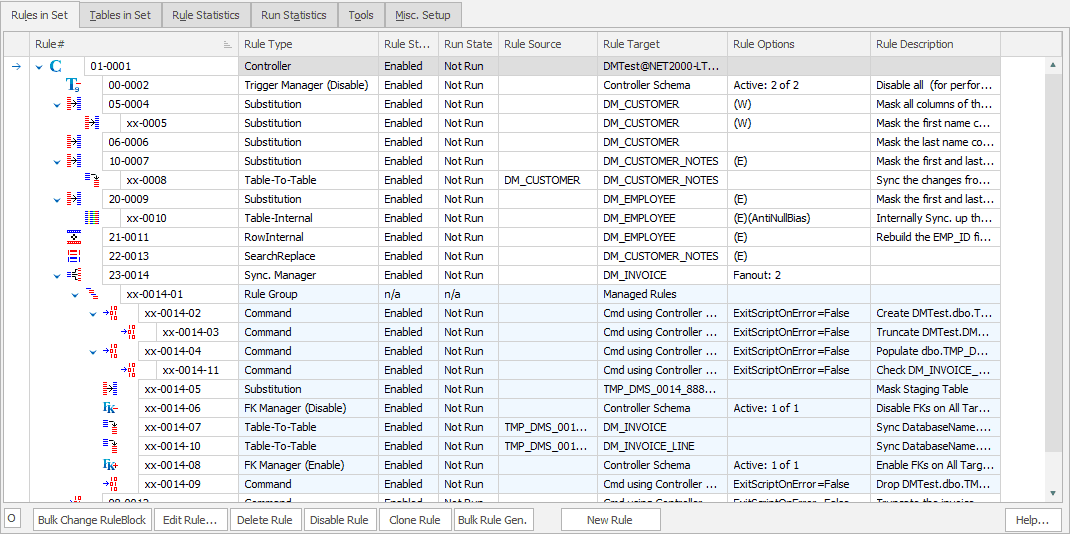
Yes. This is called synchronization and there are three basic types: Row-Internal, Table-Internal and Table-To-Table. The Data Masker software supports all three types and contains a specific rule to enable each one.

[03.11] Can I synchronize the data in one column of a table with the data in another column without changing the data in the first column?

Sure. Just use a Table-To-Table Synchronization rule.
[03.12] Can I apply a rule to synchronize the data between tables in different databases?
Yes, as long as the database is in the same SQL Server instance and the Rule Controller login has the access rights to update the target table. This is just a variation on a standard Table-To-Table Synchronization rule.
[03.13] Can I make one rule only execute after another rule completes?
Yes, just use the mouse to drag and drop it so that it is further down the list than the previous rule. In the Data Masker for SQL Server client software, rules always execute in the visible screen order. A rule will not execute until every previous rule successfully completes.


[Net 2000 Ltd. Home][Data Masker Home][Data Masker Manual]